Showing posts with label portfolio. Show all posts

Sunday, September 18, 2016

Wachenheim's Simple Insider Tricks Can Vastly Improve Your Portfolio

Edgar Wachenheim is one of the best investors you’ve never of. He keeps a low profile, but his track record is outstanding. Wachenheim is the chairman and chief portfolio manager of New York’s Greenhaven Associates. The firm manages about $5.5 billion. And over the past 25 years, it’s posted average annual returns of almost 19%.

I’m always interested in studying how great investors do what they do. In this case, Wachenheim made it easy. He wrote a book: Common Stocks & Common Sense (2016). I’m an investing junkie. I’ve read hundreds of books, interviews, and articles about great investors and their process. And it is striking how much they have in common and what it can teach you.

How to Avoid Mediocre Results

One of the things all great investors have in common is the ability to buck prevailing opinions.
In his book, Wachenheim tells the story of a friend he meets with periodically. “Danny” has been in the investing business for 40 years. He is very smart. He has an Ivy League education. His resume is top gun all the way.

Yet, his investment results are mediocre at best. Why? Because Danny can’t get past today’s concerns.
Wachenheim says that they often talk stocks. Wachenheim will mention one that he likes – usually a depressed stock facing some temporary problem. Danny never buys these stocks. Instead, he waits for some signal that the problem has eased before he buys. Naturally, by that time, the best of the stock’s appreciation story is over. Danny confines himself to mediocrity because he waits until the coast is clear.

My own experience is similar. I can’t tell you how many times I get feedback from a reader that will criticize a stock pick by citing all the usual problems with it that anybody can find in a newspaper. Wachenheim (and I) didn’t get our track records buying other people’s prettily wrapped merchandise. We bought what was on sale – because most people weren’t buying.

When You Should Never Sell

Another trait that all the great investors have is the ability to weather market declines. They don’t sell if there is no fundamental reason to do so. Yet most amateurs (and even some pros) will sell a stock for no other reason than it’s gone down in price.

Wachenheim writes about a friend who sold stock in the 1987 crash, which is a good example because almost all stocks went down that day. (Thus, there were no fundamental – or stock-specific – reasons driving the decline.)

Here is Wachenheim:
I was dismayed by my friend’s logic – or, rather, lack of logic. Let us assume that my friend owned stock X on October 18 because he believed it was worth $14 versus its then selling price of $10. Let us further assume that the stock fell in line with the market on October 19 and closed the day at $7.90. My friend intended to sell the stock at $7.90 even though a day earlier he believed it was worth $14. Such a sale would be nonsensical.
It is nonsensical. And yet a lot of people do it. Wachenheim and I don’t. When the market offers our goods on sale, we’re more likely to buy more than sell. Good ideas are hard to find. Don’t let the market take you out of them.

Case Studies Reveal All of Wachenheim’s Tricks

Most of Wachenheim’s book is given over to case studies of stocks he’s owned: IBM, Interstate Bakeries, Centex, AIG, Lowe’s, Whirlpool, Boeing, and more. He tells you his thinking at the time he bought them. You get to see how these play out and how Wachenheim handled the rallies, dips, and changing stories.

Unless you are an investing junkie like me, you might not find the case studies a thrilling read. But there are lots of good lessons in these chapters. For example, Wachenheim bought tech giant IBM and sold it at $20 about a year later for a 40% gain. But he realized he made a mistake. The IBM story was better than he thought. So he bought it back at a higher price – about $24 per share. Eventually, the shares would trade for $60.

This is something that is very hard to do. Most investors would anchor on what they sold IBM for and would not buy it back that much higher. But great investors never think in terms of price alone. It is always price as compared to what they think a stock could be worth.

Another interesting lesson from IBM is that the once great company struggled for a good 15 year span. Wachenheim uses it to show that you can’t hold any stock forever – that you have to watch it:
I strongly disagree that the shares of most wonderful businesses can be held forever because most wonderful businesses become less wonderful over time – and many eventually run into difficulties. IBM is one example of why most stocks cannot be held forever. Kodak is another. Coca Cola is a third.
The case study on Interstate Bakeries (IB) shows the importance of betting on managers who have skin in the game. Wachenheim became interested in IB when an investor named Howard Berkowitz bought 12% of the stock, became chairman of the board, and appointed a new CEO. Berkowitz had a good track record, and Wachenheim knew he wouldn’t put that much in one company unless he was sure he had a good thing.
Long story short, Wachenheim buys in too, after doing his own analysis. Two years later, Berkowitz sells the company and Greenhaven more than doubles its money.

This is a tried and true part of my own playbook. Of the six stocks we own in Bonner Private Portfolio, investors control four of them. They have skin in the game. And that’s plenty of motivation to make good on the shares. In his case studies, Wachenheim doesn’t just focus on successes. There are failures, too. But Wachenheim makes an important point about failure: Just because you lose money on a stock doesn’t mean you made a mistake. There is luck involved in markets. Sometimes you get unlucky. You get dealt a pair of aces. And you still lose to three tens. It happens. It doesn’t mean when you get another pair of aces that you shouldn’t play.

Some Essential Dos and Don’ts

After the case studies, Wachenheim lists 25 bullet points of dos and don’ts.....Here’s a sampling

*Be wary of companies that have been largely ‘put together’ through recent acquisitions.
One reason is that there is a good chance that the acquiring company had to pay high prices to make those acquisitions. In which case, future returns are not likely to be attractive.

*Do not be overly influenced by the media.
Publications of all sorts regularly call for disasters, most of which never materialize. You have to be able to screen out big-picture stuff that nobody can predict. Focus on finding good businesses at good prices.

*Favor managements who are highly incentivized to achieve higher prices for their shares.
The first thing I read when I look at a company is the “proxy.” That document tells you how management gets paid. It also tells you how much stock they own. Incentives rule the world. Don’t bother investing with people who have no incentive to work for you.

*Do not attempt to time the stock market.
An oldie and a goodie, and yet it is amazing how many people are still trying to “call the market.” They’re wasting your time.

*Structure a concentrated portfolio.
Wachenheim points out that a portfolio of 15 to 25 stocks ought to do better than 30 to 50. Again, good ideas are hard to find. Don’t spread yourself thin. I go even further than Wachenheim – 10 to 15 ideas are all you need. Maybe even less. In my personal portfolio, I own just seven stocks at the moment.

There is, of course, a lot more in the book than I can summarize here. If you are interested in becoming a better investor, then you should read Common Stocks & Common Sense. It’ll be good for you, like eating your vegetables. Otherwise, you ignore its lessons at your peril. Don’t confine yourself to the lot of mediocrity. Learn from the best.

Sincerely,
Chris Mayer

As we said earlier, Chris has one of the top track records in the business. And for the first time ever, he’s hosting a brand new investment masterclass. In this series of short training videos, Chris will show you how to find the next Starbucks, Apple, or Berkshire Hathaway. Stocks with the potential to return 10x your money or possibly more long before Wall Street is paying any attention to them.

Chris is even going to reveal six stocks from his watch list to those who participate.

Chris’ FREE masterclass starts tomorrow. Click Here to Reserve Your Spot


The article Weekend Edition: These Simple Insider Tricks Can Vastly Improve Your Returns was originally published at caseyresearch.com.


Sunday, June 26, 2016

Don Kaufman shows us how to "Protect & Profit" in any Market

Today we want to introduce the newest member of our team, Don Kaufman. Don has made quite a mark in the last couple months with the introduction of his new TheoTrade program. Truth is, some of our readers have stated they are getting more from his free videos then some of the more expensive programs they have purchased.

Don will be bringing us a free webinar monthly to keep us on the cutting edge of these extremely volatile markets. Just take advantage of any one of his free items. Getting his free eBook or even just watching his most recent free video will guarantee that you will get notified of the free webinars.

So what's in the "How to Protect & Profit in Any Market" eBook?

This 50 page eBook [visit here for free download] will teach you what you need to know to start playing the markets instead of the markets playing you.

Your Portfolio Deserves More Than a 50/50 Chance 
It has been shown statistically, over the long run, that fundamental and technical analysis is right about 50% of the time. Flipping a coin will give you the same percentage. As the author of A Random Walk Down Wall Street, Malkiel states, “Technical and Fundamental analysis is a science giving astrology a good name.” Why flip a coin when you can use high probability options strategies?

Diversification is Dead
As a Wall Street saying goes, "When they raid the house they take everyone." Professionals consider diversification as a hedge for people who don’t know how to hedge. Think about it - would you protect the value of your own home against a potential fire by diversifying, that is, buying two houses so if one burns down, the appreciation in the other offsets your loss? Of course not! You insure your home so if it burns down, the insurance covers most of the loss. Welcome to one aspect of using options. Real professionals know how to use options to protect their portfolio from any shock to the markets.

Be The House 
Today, investing in the stock market is a big gamble, almost like going to Vegas and playing the slots. And we all know what happens with slot machines. The House always wins. It may take a loss occasionally, but the overall strategy assures that the House will always come out on top. Options let's you turn the tide and be the house. Find out how you can put the odds in your favor.

Get Don's FREE eBook "The Rebel's Guide to Trading Options"....Just Visit Here!

See you in the markets,
Hedge Fund University

About Don Kaufman 
Don is one of the industry's leading financial strategists and educational authorities with 18 years of financial industry experience. Prior to co-founding TheoTrade, Mr. Kaufman spent 6 years at TD Ameritrade as Director of the Trader Group. At TD Ameritrade Mr. Kaufman handled thinkorswim® content and client education which included the design, build, and execution of what has become the industry standard in financial education. He started his career at thinkorswim® in 2000 (acquired by TD Ameritrade in 2009), where he served as chief derivatives instructor, helping the firm progress into the industry leader in retail options trading and investor education services.

Sunday, March 8, 2015

What Top Hedge Fund Managers Really Think About Gold

By Jeff Clark, Senior Precious Metals Analyst

In the January BIG GOLD, I interviewed a plethora of experts on their views about gold for this year. The issue was so popular that we decided to republish a portion of the edition here.

Given their level of success, these fund managers are worth listening to: James Rickards, Chris Martenson, Steve Henningsen, Grant Williams, and Brent Johnson. Some questions are the same, while others were tailored to their particular expertise.

I hope you find their comments as insightful and useful as I did…...

James Rickards is chief global strategist at the West Shore Funds, editor of Strategic Intelligence, a monthly newsletter, and director of the James Rickards Project, an inquiry into the complex dynamics of geopolitics and global capital. He is the author of the New York Times best  seller The Death of Money and the national best seller Currency Wars.

He’s a portfolio manager, lawyer, and economist, and has held senior positions at Citibank, Long Term Capital Management (LTCM), and Caxton Associates. In 1998, he was the principal negotiator of the rescue of LTCM sponsored by the Federal Reserve. He’s an op-ed contributor to the Financial Times, Evening Standard, New York Times, and Washington Post, and has been interviewed by the BBC, CNN, NPR, C-SPAN, CNBC, Bloomberg, Fox, and the Wall Street Journal.

Jeff: Your book The Death of Money does not paint an optimistic economic picture. What will the average citizen experience if events play out as you expect?

James: The end result of current developments in the international monetary system will almost certainly be high inflation or borderline hyperinflation in US dollars, but this process will take a few years to play out, and we may experience mild deflation first. Right now, global markets want to deflate, yet central banks must achieve inflation in order to make sovereign debt loads sustainable. The result is an unstable balance between natural deflation and policy inflation. The more deflation persists in the form of lower prices for oil and other commodities, the more central banks must persist in monetary easing. Eventually inflation will prevail, but it will be through a volatile and unstable process.

Jeff: The gold price has been in a downtrend for three years. Is the case for gold over? If not, what do you think kick-starts a new bull market?

James: The case for gold is not over—in fact, things are just getting interesting. I seldom think about the “price” of gold. I think of gold as money and everything else as a price measured in gold units. When the dollar price of gold is said to be “down,” I think of gold as a constant store of value and that the dollar is simply “up” in the sense that it takes more units of gold to buy one dollar. This perspective is helpful, because gold can be “down” in dollars but “up” in yen at the same time, and often is when the yen is collapsing against the dollar.

The reason gold is thought to be “down” is because the dollar is strong. However, a strong dollar is deflationary at a time when the Fed’s declared policy is to get inflation. Therefore, I expect the Fed will not raise interest rates in 2015 due to US economic weakness and because they do not want a stronger dollar. When that realization sinks in, the dollar should move lower and gold higher when measured in dollar terms.

The looming global shortage of physical gold relative to demand also presages a short squeeze on the paper gold edifice of futures, options, unallocated forward sales, and ETFs. The new bull market will be kick started when markets realize the Fed cannot raise rates in 2015 and when the Fed finds it necessary to do more quantitative easing, probably in early 2016.

Jeff: Given what you see coming, how should the average retail investor position his or her portfolio?

James: Since risks are balanced between deflation and inflation in the short run, a sound portfolio should be prepared for both. Investors should have gold, silver, land, fine art, and other hard assets as an inflation hedge. They should have cash and US Treasury 10-year notes as a deflation hedge. They should also include some carefully selected alternatives, including global macro hedge funds and venture capital investments for alpha. Investors should avoid emerging markets, junk bonds, and tech stocks.

Steve Henningsen is chief investment strategist and partner at The Wealth Conservancy in Boulder, CO, a firm that specializes in wealth coaching, planning, and investment management for inheritors focused on preservation of capital. He is a lifetime student, traveler, fiduciary, and skeptic.

Jeff: The Fed and other central banks have kept the economy and markets propped up longer than some thought they could. How much longer do you envision them being able to do so? Or has the Fed really staved off crisis?

Steve: I do not believe we are under a new economic paradigm whereupon a nation can resolve its solvency problem via increasing debt. As to how long the central banks’ plate spinning can defer the consequences of the past 30-plus years of excess credit growth, I hesitate to answer, as I never thought they would get this far without breaking a plate. However incorrect my timing has been over the past two years, though, I am beginning to doubt that they can last another 12 months. Twice in the last few months the stock market plates began to wobble, only to have Fed performers step in to steady the display.

With the end of QE, a slowing global economy, a strengthening dollar, and the recent sharp drop in oil prices, deflationary winds are picking up going into 2015, making their balancing act yet more difficult. (Not to mention increasing tension from poking a stick at the Russian bear.)

Jeff: Gold has been in decline for over three years now. What changes that? Should we expect gold to remain weak for several more years?

Steve: I cannot remember an asset more maligned than gold is currently, as to even admit one owns it receives a reflexive look of pity. While most have left our shiny friend bloodied, lying in the ditch by the side of the road, there are signs of resurrection. While I’m doubtful gold will do much in the first half of 2015 due to deflationary winds and could even get dragged down with stocks should global liquidity once again dissipate, I am confident that our central banks would again step in (QE4?) and gold should regain its luster as investors finally realize the Fed is out of bullets.

The wildcard I’m watching is the massive accumulation of gold (and silver) bullion by Russia, China, and India, and the speculation behind it. Should gold be announced as part of a new monetary system via global currency or gold-backed sovereign bond issuance, then gold’s renaissance begins.

Jeff: Given what you see coming, how should the average investor position her or his portfolio?

Steve: Obviously I am holding on to our gold bullion positions, as painful as this has been. I would also maintain equity exposure via investment managers with the flexibility to go long and short. I believe this strategy will finally show its merits vs. long-only passive investments in the years ahead. I believe that for the next 6-12 months, long-term Treasuries will help balance out deflationary risks, but they are definitely not a long-term hold. Maintaining an above average level of cash will allow investors to take advantage of any equity downturns, and I would stay away from industrial commodities until the deflationary winds subside.
Precious metals equities could not be hated more and therefore represent the best value if an investor can stomach their volatility.

Grant Williams is the author of the financial newsletter Things That Make You Go Hmmm and cofounder of Real Vision Television. He has spent the last 30 years in financial markets in London, Tokyo, Hong Kong, New York, Sydney, and Singapore, and is the portfolio and strategy advisor to Vulpes Investment Management in Singapore.

Jeff: The Fed and other central banks have kept the economy and markets propped up longer than some thought possible. How much longer do you envision them being able to do so? Or has the Fed really staved off crisis?

Grant: I have repeatedly referred to a singular phenomenon over the past several years and it bears repeating as we head into 2015: for a long time, things can seem to matter to nobody until the one day when they suddenly matter to everybody. It feels as though we have never been closer to a series of such moments, any one of which has the potential to derail the narrative that central bankers and politicians have been working so hard to drive.

Whether it be Russia, Greece, the plummeting crude oil price, or a loss of control in Japan, there are a seemingly never-ending series of situations, any one (or more) of which could suddenly erupt and matter to a lot of people at the same time. Throw in the possibility that a Black Swan comes out of nowhere that nobody has thought about (even something as seemingly trivial as the recent hack of Sony Pictures by the North Koreans could set in motion events which can cascade very quickly in a geopolitical world which has so many fissures running through it), and you have the possibility that fear will replace greed overnight in the market’s collective psyche. When that happens, people will want gold.

The issue then becomes where they are going to get it from. Physical gold has been moving steadily from West to East despite the weak paper prices we have seen for the last couple of years, and this can continue until there is a sudden wider need for gold as insurance or as a currency. When that day comes, the price will move sharply from being set in the paper market—where there is essentially infinite supply—to being set in the physical markets where there is very inelastic supply and the existing stock has been moving into strong hands for several years. Materially higher prices will be the only way to resolve the imbalance.

Jeff: You’ve written a lot about the gold market over the past few years. In your view, what are the most important factors gold investors should keep in mind right now?

Grant: I think the key focus should be on two things: first, the difference between paper and physical gold; and second, on the continuing drive by national banks to repatriate gold supplies. The former is something many people who are keen followers of the gold markets understand, but it is the latter which could potentially spark what would, in effect, be a run on the gold “bank.” Because of the mass leasing and rehypothecation programs by central banks, there are multiple claims on thousands of bars of gold. The movement to repatriate gold supplies runs the risk of causing a panic by central banks.

We have already seen the beginnings of monetary policy divergence as each central bank begins to realize it is every man for himself, but if that sentiment spreads further into the gold markets, it could cause mayhem.
Keep a close eye on stories of further central bank repatriation—there is a tipping point somewhere that, once reached, will light a fire under the physical gold market the likes of which we haven’t seen before, and that tipping point could well come in 2015.

Jeff: Given what you see coming, how should the average investor position his or her portfolio?

Grant: Right now I think there are two essentials in any portfolio: cash and gold. The risk/reward skew of being in equity markets in most places around the world is just not attractive at these levels. With such anemic growth everywhere we turn, and while it looks for all the world that bond yields are set to continue falling, I think the chances of equities continuing their stellar run are remote enough to make me want out of equity markets altogether.

There are pockets of value, but they are in countries where the average investor is either disadvantaged due to a lack of local knowledge and a lack of liquidity, or there is a requirement for deep due diligence of the kind not always available to the average investor.

The other problem is the ETF phenomenon. The thirst for ETFs in order to simplify complex investing decisions, as well as to throw a blanket over an idea in order to be sure to get the “winner” within a specific theme or sector, is not a problem in a rising market (though it does tend to cause severe value dislocations amongst stocks that are included in ETFs versus those that are not). In a falling market, however, when liquidity is paramount, any sudden upsurge of selling in the ETF space will require the underlying equities be sold into what may very well be a very thin market.

In a rising market, there is always an offer. In a falling market, bids can be hard to come by and in many cases, nonexistent, so anybody expecting to divest themselves of ETF positions in a 2008 like market could well find themselves with their own personal Flash Crash on their hands.

Unlevered physical gold has no counterparty risk and has sustained a bid for 6,000 straight years (and counting). Though sometimes, in the wee small hours, those bids can be both a little sparse and yet strangely attractive to certain sellers of size.

Meanwhile, a healthy allocation to cash offers a supply of dry powder that can be used to gain entry points which will hugely amplify both the chances of outperformance and the level of that performance in the coming years.

Remember, you make your money when you buy an asset, not when you sell it.

Caveat emptor.

Chris Martenson, PhD (Duke), MBA (Cornell), is an economic researcher and futurist who specializes in energy and resource depletion, and is cofounder of Peak Prosperity. As one of the early econobloggers who forecasted the housing market collapse and stock market correction years in advance, Chris rose to prominence with the launch of his seminal video seminar, The Crash Course, which has also been published in book form.

Jeff: The Fed and other central banks have kept the economy and markets propped up longer than some thought possible. How much longer do you envision them being able to do so? Or has the Fed really staved off crisis?

Chris: Well, if people were being rational, all of this would have stopped a very long time ago. There’s no possibility of paying off current debts, let alone liabilities, and yet “investors” are snapping up Italian 10 year debt at 2.0%! Or Japanese government bonds at nearly 0% when the total debt load in Japan is already around $1 million per rapidly aging person and growing. I cannot say how much longer so called investors are willing to remain irrational, but if pressed I would be very surprised if we make it past 2016 without a major financial crisis happening.

Of course, this bubble is really a bubble of faith, and its main derivative is faith based currency. And it’s global. Bubbles take time to burst roughly proportional to their size, and these nested bubbles the Fed and other central banks have engineered are by far the largest ever in human history.

As always, bubbles are always in search of a pin, and we cannot know exactly when that will be or what will finally be blamed. All we can do is be prepared.

Jeff: If deflationary forces pick up, how do you expect gold to perform?

Chris: Badly at first, and then spectacularly well. It’s like why the dollar is rising right now. Not because it’s a vastly superior currency, but because it’s the mathematical outcome of trillions of dollars’ worth of US dollar carry trades being unwound. So the first act in a global deflation is for the dollar to rise. Similarly, the first act is for gold to get sold by all of the speculators that are long and need to raise cash to unwind other parts of their trade books.

But the second act is for people to realize that the institutions and even whole nation states involved in the deflationary mess are not to be trusted. With opaque accounting and massive derivative positions, nobody will really know who is solvent and who isn’t. This is when gold gets “rediscovered” by everyone as the monetary asset that is free of counterparty risk—assuming you own and possess physical bullion, of course, not paper claims that purport to be the same thing but are not.

Jeff: Given what you see coming, how should the average investor position her or his portfolio?

Chris: Away from paper and toward real things. If the outstanding claims are too large, or too pricey, or both, then history is clear; the perceived value of those paper claims will fall.

My preferences are for land, precious metals, select real estate, and solid enterprises that produce real things. Our view at Peak Prosperity is that deflation is now winning the game, despite everything the central banks have attempted, and that the very last place you want to be is simply long a bunch of paper claims.

However, before the destruction of the currency systems involved, there will be a final act of desperation by the central banks that will involve printing money that goes directly to consumers. Perhaps it will be tax breaks or even rebates for prior years, or even the direct deposit of money into bank accounts.

When this last act of desperation arrives, you’ll want to be out of anything that looks or smells like currency and into anything you can get your hot little hands on. This may include equities and other forms of paper wealth—just not the currency itself. You’ll want to run, not walk, with a well-curated list of things to buy and spend all your currency on before the next guy does.

We’re not there yet, but we’re on our way. Expect the big deflation to happen first and then be alert for the inevitable central bank print a thon response.

Because of this view, we believe that having a very well balanced portfolio is key, with the idea that now is the time to either begin navigating toward real things, or to at least have that plan in place so that after the deflationary impulse works its destructive magic, you are ready to pounce.

Brent Johnson is CEO of Santiago Capital, a gold fund for accredited investors to gain exposure to gold and silver bullion stored outside the United States and outside of the banking system, in addition to precious metals mining equities. Brent is also a managing director at Baker Avenue Asset Management, where he specializes in creating comprehensive wealth management strategies for the individual portfolios of high-net-worth clients. He’s also worked at Credit Suisse as vice president in its private client group, and at Donaldson, Lufkin & Jenrette (DLJ) in New York City.

Jeff: The Fed and other central banks have kept the economy and markets propped up longer than some thought possible. How much longer do you envision them being able to do so? Or has the Fed really staved off crisis?

Brent: As much as I dislike the central planners, from a Machiavellian perspective you really have to give them credit for extending their influence for as long as they have. I wasn’t surprised they could engineer a short-term recovery, and that’s why, even though I manage a precious metals fund, I don’t recommend clients put all their money in gold. But I must admit that I have been surprised by the duration of the bull market in equities and the bear market in gold. And while I probably shouldn’t be, I’m continually surprised by the willingness of the investing public to just accept as fact everything the central planners tell them. The recovery is by no means permanent and is ultimately going to end very, very badly.

But I don’t have a crystal ball that tells me how much longer this movie will last. My guess is that we are much closer to the end than the beginning. So while they could potentially draw this out another year, it wouldn’t surprise me at all to see it all blow up tomorrow, because this is all very much contrived. That’s why I continue to hold gold. It is the ultimate form of payment and cannot be destroyed by either inflation, deflation, central bank arrogance, or whatever other shock exerts itself into the markets.

Jeff: As a gold fund manager, you’ve watched gold decline for over three years now. What changes that? And when? Should we expect gold to remain weak for several more years?

Gold has been in one of its longest bear markets in history. Many of us in the gold world must face up to this. We have been wrong on the direction of gold for three years now. Is this due to bullion banks trying to maximize their quarterly bonuses by fleecing the retail investor? Is it due to coordination at the central bank level to prolong the life of fiat currency? Is it due to the Western world not truly understanding the power of gold and surrendering our bullion to the East? I don’t know… maybe it’s a combination of all three. Or maybe it’s something else altogether.

What I do know is that gold is still down. Now the good news is… that’s okay. It’s okay because it isn’t going to stay down. The whole point of investing is to arbitrage the difference between price and value. And right now there remains a huge arbitrage to exploit. As Jim Grant said, “Investing is about having people agree with you… later.”

Now all that said, I realize it hasn’t been a fun three years. This isn’t a game for little boys, and I’ve felt as much pain as anyone. I think the trend is likely to change when the public’s belief in the central banks starts coming into question. We are starting to see the cracks in their omnipotence. For the most part, however, investors still believe that not only will the central banks try to bail out the markets if it comes to that, but they also still believe the central banks will be successful when they try. In my opinion, they are wrong.

And there are several catalysts that could spark this change—oil, Russia, other emerging markets, or the ECB and Japan monetizing the debt. This “recovery” has gone on for a long time. But from a mathematical perspective, it simply can’t go on forever. So as I’ve said before, if you believe in math, buy gold.

Jeff: Given what you see coming, how should the average investor position her or his portfolio?

Brent: The answer to this depends on several factors. It depends on the investor’s age, asset level, income level, goals, tolerance for volatility, etc. But in general, I’m a big believer in the idea of the “permanent portfolio.” If you held equal parts fixed income, equities, real estate, and gold over the last 40 years, your return is equal to that of the S&P 500 with substantially less volatility. And this portfolio will perform through inflation, deflation, hyperinflation, collapse, etc.

So if you are someone who is looking to protect your wealth without a lot of volatility, this is a very strong solution. If you are younger, are trying to create wealth, and have some years to ride out potential volatility, I would skew this more toward a higher allocation to gold and gold shares and less on fixed income, for example.

Because while I generally view gold as insurance, this space also has the ability to generate phenomenal returns and not just protect wealth, but create it. But whatever the case, regardless of your age, level of wealth, or world view, the correct allocation to gold in your portfolio is absolutely not zero. Gold will do phenomenally well in the years ahead, and those investors who are willing to take a contrarian stance stand to benefit not only from gold’s safety, but also its ability to generate wealth.

One other thing to remember about gold is that while it may be volatile, it’s not risky. Volatility is the fluctuation in an asset’s daily/weekly price. Risk is the likelihood of a permanent loss of capital. And with gold (in bullion form), there is essentially no chance of a permanent loss of capital. It is the one asset that has held its value not just over the years, but over the centuries. I for one do not hold myself out as being smarter than thousands of years of collective global wisdom. If you do, I wish you the best of luck!

Of course, bullish signs for gold have been mounting, which begs the question: could the breakthrough for the gold market be near?

Well, no one knows for sure. But what we do know is that when the market recovers, the handful of superb mining stocks that have survived the slaughter won’t just go up—they’ll go vertical.

Which is why we're hosting a free online event called, GOING VERTICAL, headlined by a panel of eight top players in the precious metals sector, names you'll no doubt recognize. Each of our guests give their assessment on where the gold market is right now, how long it will take to recovery, and what practical steps you need to take to prepare including - which stocks you should own now.

This free video event will air March 10th, 2pm Eastern time. To make sure you don't miss it, click here to register now.


Get our latest FREE eBook "Understanding Options"....Just Click Here!

Sunday, March 1, 2015

A Math Free Guide to Higher and Safer Returns

By Andrey Dashkov

I can make you instantly richer, and safely, by explaining a finance concept with a story about a dog.

There’s a hole in your pocket you probably don’t know about. You may feel instinctively that something is wrong, but unless you look in the right place, you won’t find the problem. The money you’re losing doesn’t appear in the minus column on your account statements, but you’re losing it nevertheless.

Frustrated? Don’t be. I’m going to tell you where to look and how to stop the drainage.

Volatility is every investor’s worst enemy. Over time, it poisons your returns. Unlike a 2008 style market drop, though, volatility poisons them slowly. There’s no obvious ailment to discuss with friends or hear about on CNBC. You only see it when you compare how much you lost to how much you could have earned—and looking back at your own mistakes is not a pleasant thing to do.

Here's the Replay of Last Nights Free Webinar....."Options and Premium Decay"

So instead let’s imagine two fictional companies: X-Cite, Inc., an amusement park operator with a volatile stock price that adventurous investors love; and Glacial Corp., a dull, defensive sloth of a corporation whose stock returns are consistent but often lower than those of its more glamorous counterpart.

Average return on both companies’ stocks was 5% for the past five years, but Glacial’s was less volatile. Safety is comfortable, but doesn’t higher volatility mean higher potential returns? Sometimes, but not always. When you accept high volatility, your returns might be higher at times, but they also might be lower. In other words, higher volatility generally means greater risk.

Nothing new so far, but the oft-overlooked point is that boring stocks make you richer over time.
The chart below shows each stock’s annual return over a five year period.


At first glance, Glacial Corp. appears to be the loser. It underperformed X-Cite in four out of five years. Both stocks returned 5% on average during these years, and X-Cite was almost always voted the prettiest girl in town. But for Year 3, it would be easy to persuade investors to buy X-Cite stock. Few would give Glacial a second glance.

Hold for the punchline: X-Cite, the stock your broker would have a much easier time selling you (before you read this article), would actually make you poorer. Let me explain.

I won’t get into any supercharged math here. Glacial is better because it makes you richer eventually. After five years, the total return on X-Cite is 25%. Not bad. Glacial? 27%. If you invested $10,000 in both (assuming no brokerage fees or taxes), at the end of Year 5 you would have earned $2,507 on X-Cite or $2,701 on Glacial.

Year-End Account Balance
X-Cite, Inc.
Glacial Corp.
Year 1
$10,500
$10,300
Year 2
$11,550
$11,021
Year 3
$10,164
$10,801
Year 4
$10,875
$11,341
Year 5
$12,507
$12,701
Total return
25%
27%


Where does the extra $194 come from? It comes from lower volatility. Although X-Cite looks like a winner most of the time, it has a higher standard deviation of returns. Note that X-Cite’s stock price dropped 12% in Year 3. The following year it increased 7%, while Glacial Corp.’s stock price only increased 5%—yet Glacial is still worth more from Year 3 onward. Why? X-Cite’s 7% jump is based on the previous year’s low.

But I promised to keep this note math-free, so imagine a person walking a dog instead. The shorter the leash, the less space the dog has to run around. The longer the leash, the more erratic the dog’s path will be. Standard deviation measures how much data tend to scatter around its mean—the path. As we just saw, low standard deviation also pays you money.

I could stop right here and hope that you take this lesson to heart, but I won’t. As much as I love describing finance concepts using clever company names and dogs, I want you to start making money right now.

I said this advice could make you instantly richer, and “instantly” doesn’t mean “maybe sometime in the future.” In the latest issue of Money Forever, we shared an opportunity to invest into a vehicle built to outperform the market by managing volatility. I was extremely excited to present it to our paid subscribers because I knew they’d love to earn more by risking less. Who wouldn’t?

So please pardon my blatant self-promotion. I work in an industry where 80% of the time the market is obsessed with the wrong stock, and the noise drowns out the right idea. I can silence the cacophony for you, though, and show you where to find the right ideas. And that goes beyond our most recent pick, although you do need it in your portfolio. Money Forever’s mission is to make your money last—plain and simple.

We think this pick will go a long way toward doing just that.

You can check it out and access our full portfolio immediately by subscribing risk free to Money Forever.

It’s about the price of Netflix, but unlike Netflix we won’t bother you if you decide to cancel. In fact, we’re so confident that the Money Forever portfolio can help you “earn more by risking less” that we’ll refund 100% of the cost if you decide to cancel within the first three months.

And we’ll even prorate your refund after that—it’s a no lose proposition. Click here to start earning more by risking less now.

The article A Math-Free Guide to Higher and Safer Returns was originally published at millersmoney.com.


Get our latest FREE eBook "Understanding Options"....Just Click Here!

Friday, February 20, 2015

Simple Strategy Alert: Premium Decay

We all think we know what premium decay is right? Well, I thought I knew how it worked until I watched this new video from our trading partner John Carter of Simpler Options. I never knew just how powerful and simple it was to apply knowledge of the decay principal to trading options.

Basically it's a way to insure the health of your portfolio even in an unhealthy market.

In this free video John shows us a simple and effective strategy for using premium decay, but he also shows you his strategy to make money on a stock whether it's going up or down.


Here's a sample of what John will share with us.....

  *  How to “control” stocks for a fraction of the price so you don’t risk all your capital - How you can
      generate consistent returns being dead wrong

  *  What “premium decay” is and how you can use to it to give yourself an edge in trading

  *  How you can set up occasional home run trades while generating consistent returns

  *  A handful of the key stocks I look at every day so you don’t go bug eyed looking for stocks to trade


Don't miss the game changing video "Simple Strategy Alert: Premium Decay"....Watch Video Now


John Carter has become well known for his wildly popular free options trading webinars and his free options trading eBook that changed the way traders looked at options trading in 2014.

Download the free eBook HereWhile you still can!

Wednesday, October 22, 2014

How to Invest in a Difficult Market

By Casey Research

Many experts hold dim views of the current state of the US economy—but what’s a prudent investor to do to make a profit? Find out what the blue-ribbon faculty of economists and investment pros at the recently concluded Casey Research Fall Summit thought.

Lacy Hunt, senior executive VP of Hoisington Investment Management Company and former chief economist at the Dallas Fed, says the main reason that the global economy continues to falter is that all countries borrow too much and save too little.

“275% total debt to GDP is the critical threshold. Every world economy of importance is above that level and moving higher.” He finds today’s monetary policy “impotent.” The Fed, Bank of England, and Bank of Japan are trying to solve the problem of too much debt by borrowing more, which has short-term benefits, but will be disastrous long term.

Too much borrowing, says Hunt, guarantees that we’ll get more asset bubbles. Because the United States is the least indebted of the three countries, it will continue to outperform Japan and Europe. He predicts that the dollar will rise against other major currencies and that inflation, as well as interest rates, will remain low.

Christian Menegatti, managing director of economic research at Roubini Global Economics, is convinced that we’re at the end of a supercycle and won’t see a normalization of monetary policy for quite some time.
Like Lacy Hunt, Menegatti predicts that global interest rates will stay low. On the positive side, he doesn’t believe that we will see secular stagnation; in other words, a full “Japanification” of the US is unlikely.

The current economic recovery in the US is weaker than that in the 1930s, claims Worth Wray, chief strategist at Mauldin Economics. He says while nominal interest rates are the lowest they've ever been, real rates could go lower.

When the Fed’s QE3 is over, he predicts that growth will weaken and rates will fall further. “Without another dose of stimulus, the US will likely slide into recession.”

Taking a global view, he thinks that China’s slowdown could cause the Australian housing bubble to pop, and that commodity prices will drop over the next few years, which will hurt resource rich countries like Australia, Norway, and Canada.

He recommends to buy U.S. Treasuries and to diversify across asset classes that thrive in different economic environments to strengthen your portfolio against a possible crisis.

Diversification is also the number one tip from the expert panel on “Building a Crisis Proof Portfolio” at the Casey Summit, consisting of Worth Wray and Casey editors Alex Daley, Terry Coxon, Dan Steinhart, and Dennis Miller.

They say a crisis can take one of two forms:
  1. A “standard” crisis, where stocks crash but the financial system remains intact. In that scenario, you want to own US government bonds because they’ll retain their safe-haven properties.
  1. A “reset,” meaning a complete implosion of the global financial system. Government bonds won’t save you from that type of crisis. Instead, you’d want to own real, non-financial assets, such as physical gold and silver, as well as farmland and other real estate.
For “Future Tech You Can Profit from Now,” Alex Daley, chief technology investment strategist at Casey Research, suggests to look for companies that offer game changing benefits or savings and that focus on “where businesses and people spend their time and money,” like OpenTable or Zillow.

Daley recommends three companies with great upside from his Casey Extraordinary Technology portfolio.
He says there’s no need to worry about the broader market if you can find great companies with consistent growth. “Look for 40% revenue growth over the same quarter last year; that’s the magic number.”

To get all of Alex Daley’s stock picks (and those of the other speakers), as well as every single presentation of the Summit, order your 26+-hour Summit Audio Collection now. It’s available in CD and/or MP3 format. Learn more here.


The article How to Invest in a Difficult Market was originally published at casey research


Get our latest FREE eBook "Understanding Options"....Just Click Here!

Thursday, September 11, 2014

Floating Rate Funds Poised to Profit as Interest Rates Rise

By Andrey Dashkov

Money can’t be this cheap forever. In other words, one of the most likely scenarios the U.S. economy faces is rising interest rates. The current low interest rate climate is simply unsustainable. At some point—as it always does—the trend will turn around. We want to be prepared for that turn, and the right floating-rate fund can help.

A floating rate loan is a bank loan with interest that’s tied to some benchmark rate, often the London Interbank Offer Rate (LIBOR). When the LIBOR changes, so does the loan’s coupon. The rate is adjusted every 30 - 90 days. Floating rate funds are pools of capital that invest in these loans, earn variable-rate interest, and pay dividends that are themselves flexible.

Variable Dividends Boost Immunity


Variable dividends are the key feature of floating rate funds. They’re what separate floating rate funds from the rest of the debt market. Flexible dividends make shares of the bond funds immune to rising interest rates; the prices of the bonds and the fund’s shares don’t get punished when rates go up. What the investor sees is higher dividends; his principal is safe.

A note of caution is in order here: Even though floating rate bonds don’t have the same inverse price-yield relationship as fixed rate debt instruments, their prices can still go down. Although the automatic coupon adjustments mostly eliminate the first major risk of any debt instrument—interest-rate risk—floating-rate funds still hold the other major risk: credit risk. As a reminder, credit risk is the risk that the borrower won’t make payments on time or will default on the debt entirely.

The credit risk of floating rate loans is high because the companies that borrow under these conditions are usually rated below investment grade. They can’t go to capital markets for money because fixed rate loans would be too expensive, so they turn to banks that provide funds on floating rate terms.

Since the companies borrowing these funds are below investment grade, their default rates are close to those of speculative grade bonds. Vanguard Research reports that the average annual default rate from 1996 to 2012 for speculative grade bonds was 4.5%; for senior floating rate loans, it was 3.4%. Better, but still much higher than investment-grade bonds at 0.1%.

High Post - Default Recovery Rates


Does this mean that you should avoid floating rate loans in favor of AAA-rated debt? No. First, floating-rate loans are high in a companies’ debt structure, which means that if the borrower defaults, investors holding floating rate debt have a priority claim on the company’s assets. This leads to very high recovery rates for senior floating rate loans in the event of default: 71.1%, or more than 70 cents on the dollar. Compare that to the next class of loans, senior secured, which are recovered at a rate of 56.8%.

Second, floating rate loans outperform both high yield loans and the aggregate U.S. bond market. According to Vanguard, during the last three rising rate periods (January 1994-February 1995, June 1999-May 2000, and June 2004-June 2006) floating rate bonds outperformed high yield instruments by 2.5 percentage points (pp) and the aggregate bond market by 4.3 pp.

After the rising rate periods end, however, floating rate funds tend to underperform both high yield instruments and the overall bond market. This is why we’re buying them now, when rates have nowhere to go but up. We don’t know when that will happen, but when it does, we want to be positioned to profit.
In addition to their excellent performance in rising interest rate periods, floating rate funds are good for diversification. Their correlation with the overall US bond market is close to zero, which makes them especially good for a portfolio focused on fixed-rate US bonds. However, they also belong in our retirement portfolio—the Money Forever portfolio—where we use them to diversify our allocation across various debt instruments and to make sure we are well positioned to profit from rising interest rates.

Entrée into the World of Big Money


To sum it up, floating rate funds provide a way to diversify into an investment class that is almost immune to rising interest rates. Like business development companies, floating rate funds offer retail investors entrée into an area of finance usually reserved for big money and institutions. In exchange for these opportunities, investors accept credit risk due to the low credit ratings of the borrowing companies. With that in mind, we pay close attention to the sectors of the funds we consider investing in, and prefer more defensive and crisis-resistant industries.

At Miller’s Money we closely monitor the bond market, constantly scouting out the best options for seniors and savers. Learn more need to know information about bonds and the role they play in today’s low-interest rate environment by downloading our free special report, Bond Basics today.


Make sure to check out our "Beginners Guide to Trading Options"....Just Click Here!

Friday, July 4, 2014

5 Simple Rules to Evolve Past the Hot Stock List

By Andrey Dashkov

If you’re a typical small time investor, chances are you prefer to let a team of analysts fuss about such irksome things as correlation and beta. Maybe you’ve bought a stock because your brother in law gave you a hot tip, maybe you heard something about it on a financial news show, or maybe you just loved the company’s product.


Friends often ask me for “hot stock tips”—which is like walking up to someone at the craps table and asking what number to bet on. An accomplished craps player will have position limits, stop losses, income targets, and an overall strategy that does not hinge on one roll of the dice. You need an overall strategy long before you put money down.

So, what do I tell those friends asking for hot stock tips? Well, that they can retire rich with a 50-20-30 portfolio:
  • Stocks. 50% in solid, diversified stocks providing healthy dividends and appreciation.
  • High Yield. 20% in high yield, dividend paying investments coupled with appropriate safety measures. These holdings are bought for yield; any appreciation is a nice bonus.
  • Stable Income. 30% in conservative, stable income vehicles.
Unless you’re starting entirely from scratch, you should review your current portfolio allocations, identify where you’re over or underallocated, and then look for investments to fill those holes. In our portfolio here at Miller's Money Forever, we separate our recommendations into StocksHigh Yield, and Stable Income to help you do just that.

The Art of the Pick


By the time an investment lands in our portfolio, we’ve already run it through our Five Point Balancing Test. When your boasting brother in law tempts you with a “can’t-miss opportunity” or some pundit touts a hot tech company on television, you can come back to these five points, again and again.
  1. Is it a solid company or investment vehicle? Investing your retirement money safely is a must. How do you know if a company is solid? Take the time to validate essential company information, particularly when the recommendation comes from a source with questionable motivation.
  2. Does it provide good income? A good stock combines a robust dividend and appreciation potential.
  3. Is there a good chance for appreciation? There are two types of appreciating stocks: those that rise because of general market conditions and those that rise further because of the way management runs the business. We want both.
  4. Does it protect against inflation? High inflation is one of the biggest enemies of a retirement portfolio.
  5. Is it easily reversible? Ask yourself, “Can I quickly and easily reverse this investment if something unexpected occurs?” The ability to liquidate inexpensively is critical to correcting errors.

Marking the Bull’s Eye So You Can Hit It


It’s worthwhile to write down your goal—including an income target and the price at which you’ll sell if things head south—with every investment. After all, if you can’t see the bull’s eye, how will you know if you’ve hit it? Buying any investment because a trusted adviser, newsletter, or pundit recommended it is not a good enough reason. Buying because your portfolio has a hole, you understand the company, the investment vehicle, the risks, and the potential is.

Remember, retiring rich means having enough money to enjoy your lifestyle without money worries. Do your homework on every investment and you’ll make that pleasant thought your life’s reality. Every week, the Miller’s Money team provides no nonsense, practical advice about the best ways to invest for your retirement in  Miller’s Money Weekly Sign up here to receive it every Thursday.

The article 5 Simple Rules to Evolve Past the Hot-Stock List was originally published at Millers Money


Get your seat for our next free webinar "Low VIX and What It Means to Your Trading"....Just Click Here!


Thursday, May 8, 2014

Is it Time to Admit That Gold Peaked in 2011?

By Jeff Clark, Senior Precious Metals Analyst

Have you seen this “real price of gold” chart that’s been making waves? Among other things, it purports to show the gold price adjusted for inflation over the past 223 years. Notice the 1980 vs. 2011 levels.


The chart makes it seem that on an inflation-adjusted basis, gold has matched its 1980 peak in 2011, or nearly so. A mainstream analyst who still thinks of gold as a “barbarous relic,” a government official who doesn’t want people to think of gold as money, or an Internet blogger looking for some attention might try to convince you that this proves that the gold bull market is over, arguing that the 2011 peak of $1,921 is the equivalent of the 1970s mania peak of $850 in January of 1980.

The logic is flawed, however; even if it were true that gold has matched its 1980 peak in inflation-adjusted prices, it would not prove that the top is in this time. This is not the 1970s, the global economy is under very different pressures, and there’s no rational basis at all for saying the top this time has to be at the same or similar level as last time.

That’s even if it were true that gold has matched its 1980 peak—but it hasn’t.

Inflation-Adjusted Gold Has NOT Matched Its 1980 Peak


First, if you go by official U.S. Bureau of Labor Statistic numbers, $850 in 1980 is equivalent to $2,320 in 2011, when gold hit its peak thus far in the current cycle. (It’s $2,403 in 2013 dollars, as is said to be used in the chart.)

We don’t know what data the authors of the chart used, nor their inflation adjustment method, so it’s hard to say what the problem is, but at the very least, we can say the chart is very misleading.

But there’s more. As you probably know, the government has made numerous changes to the way it calculates inflation—the Consumer Price Index (CPI)—since 1980. So, even the BLS number we’ve given grossly underestimates the real difference between the 2011 and 1980 peaks.

For a more apples to apples comparison, we should adjust for inflation using the government’s 1980 formula. And for that, whom better to ask than John Williams of Shadow Government Statistics (AKA Shadow Stats), the world’s leading expert on phony US government statistics?

I asked John to apply the CPI formula from January 1980 to the $1,921 gold price in 2011, to give us a more accurate inflation adjusted picture. Here’s what his data show.


Using the 1980 formula, the monthly average price of gold for January 1980 would be the equivalent of $8,598.80 today. The actual peak—$850 on January 21, 1980—isn’t shown in the chart, but it would equate to a whopping $10,823.70 today.

The Shadow Stats chart paints a completely different picture than the first chart. The current CPI formula grossly dilutes just how much inflation has occurred over the past 34 years. It’s so misleading that investment decisions based on it—like whether to buy or sell gold—could wreak havoc on a portfolio.

This could easily be the end of the discussion, but there are many more reasons to believe that the gold price has not peaked for the current bull cycle…...

Percentage Rise Has Been Much Smaller


Inflation adjusted numbers are not the only measure that matters. The percentage climb during the 1970s bull market was dramatically greater than what we experienced from 2001 to 2011. Here’s a comparison of the percentage gain during both periods.


From the 1970 low to the January 1980 peak, gold rose 2,346%. It climbed only 535% from the 2001 low to the September 2011 high—nowhere near mimicking that prior bull market.

Silver Scantly Participated in the 2011 Run-Up


After 31 years of trading, silver has yet to even reach its nominal price from 1980. It surged to $48.70 in 2011—but it hit $50 in January 1980.

On an inflation-adjusted basis, using the same data from John Williams, silver would need to hit $568 to match its 1980 equivalent.

The fact that silver has lagged this much—when its greater volatility would normally move its price by a greater percentage than gold—further shows that 2011 was not the equivalent of 1980.

No Bubble Characteristics in 2011


I’ll get some arguments from the mainstream on this one. “Of course gold was in a bubble in 2011—look at the chart!”

Yes, gold had a nice run-up that year. It rose 38.6% from January 1 to the September 6 peak. Anyone holding gold at that time was very happy. But that’s not a bubble. One of the major characteristics of a bubble is that prices go parabolic.

And that’s exactly what we saw in 1979-1980:
  • In the 12 months leading up to its January 21, 1980 peak, gold surged an incredible 270%.
  • In contrast, the year leading up to the September 6, 2011 peak, the price climbed 48%—very nice, but hardly parabolic, and less than a fifth of the 1970s runaway move.

No Global Phenomenon in 1980 (Next Time It Will Be)


In the 1970s, the “mania” was mostly a North American phenomenon. China and most of Asia didn’t participate. When inflation grips the world from all the money printing governments almost everywhere have engaged in, there will be a much greater demand for gold than in 1980.

When that day comes, there will be severe consequences for those who don’t have enough bullion. Not only will the price relentlessly move higher, but finding physical gold to buy may become very difficult.

Comparable Price Moves? So What?


The argument we started with is really the clincher. It doesn’t matter how today’s gold prices compare to those from prior bull markets; what matters are the factors likely to impact the price today. Are there reasons to own gold in the current environment—or not?

First, a comparison: Apple shares surged 112% in 2007. After such a run up, surely investors should’ve dumped it, right? Well, those who did likely regretted it, since it ended that year at $180 and trades over $590 today. In fact, even though it had already risen dramatically and in spite of it crashing with the market in 2008, there were plenty of solid reasons to buy the stock then, not the least of which was the introduction of the iPhone that year.

So should we sell gold because it rose 535% in a decade? As with the Apple example above, that’s not the right question.

There are, in fact, several more relevant questions for gold today:
  • What will happen with the unprecedented amount of money that’s been printed around the world since 2008?
  • Why are economies still sluggish after the biggest monetary experiment in history?
  • Global debt and “unfunded mandates” are at never-before-seen levels; how can this conceivably be paid off?
  • Interest rates are at historically low levels—what happens when they start to rise?
  • Regardless of your political affiliation, do you trust that government leaders have the ability and willingness to do what’s necessary to restore the economy to health?
If these issues were absent, maybe we’d change our position on precious metals. But until the word “healthy” can honestly be used to describe the fiscal, monetary, and economic state of our global civilization, gold should be held as an essential wealth-protection asset.

Today’s volatile world is exactly the kind of circumstance gold is best for.

The message here is clear, my friends. Regardless of the measure, gold has not matched its 1980 peak. And the reasons to own it have not faded. Indeed, they have grown. Continue to accumulate.

Learn about the best ways to invest in gold—how and when to buy it, where to store it for maximum safety, and how to find the best gold stocks—in the free 2014 Gold Investor’s Guide.

The article Time to Admit That Gold Peaked in 2011? was originally published at Casey Research


Check out our Advanced Study on Trading the Opening Gap in Crude Oil CL


Sunday, April 27, 2014

Not All Debt Is Created Equal

By Dennis Miller

Optimal diversification: We all want it. Diversification is, after all, the holy grail of portfolio management. Our senior research analyst Andrey Dashkov has said that many times before, and he echoes that refrain in his editorial guest spot below.

A brief note before I hand over the reins to Andrey. The last time the market tanked, many of my friends suffered huge losses. They all thought their portfolios were well diversified. Many held several mutual funds and thought their plans were foolproof. Sad to say, those funds dropped in tandem with the rapidly falling market. Our readers need not suffer a similar fate.

Enter Andrey, who’s here to explain what optimal diversification is and to share concrete tools for implementing it in your own portfolio.

Take it away, Andrey…


Floating-Rate Funds Bolster Diversification

By Andrey Dashkov
Floating rate funds as an investment class are a good diversifier for a portfolio that includes stocks, bonds, and other types of investments. Here’s a bit of data to back that claim.

The chart below shows the correlation of floating rate benchmark to various subsets of the debt universe.
As a reminder, correlation is a measure of how two assets move in relation to each other. This relationship is usually measured by a correlation coefficient that ranges from -1 to +1. A coefficient of +1 says the two securities or asset types move in lockstep. A coefficient of -1 means they move in opposite directions. When one goes up, the other goes down. A correlation coefficient of 0 means they aren’t related at all and move independently.

Why Correlation Matters


Correlation matters because it helps to diversify your portfolio. If all securities in a portfolio are perfectly correlated and move in the same direction, we are, strictly speaking, screwed or elated. They’ll all move up or down together. When they win, they win big; and when they fall, they fall spectacularly. The risk is enormous.

Our goal is to create a portfolio where securities are not totally correlated. If one goes up or down, the others won’t do the same thing. This helps keep the whole portfolio afloat.

As Dennis mentioned, diversification is the holy grail of portfolio management. We based our Bulletproof strategy on it precisely because it provides safety under any economic scenario. If inflation hits, some stocks will go up, while others will go down or not react at all.

You want to hold stocks that behave differently. Our mantra is to avoid catastrophic losses in any investment under any scenario, and the Bulletproof strategy optimizes our odds of doing just that.

When “Weak” is Preferable


Now, a correlation coefficient may be calculated between stocks or whole investment classes. Stocks, various types of bonds, commodities—they all move in some relationship to one another. The relationship may be positive, negative, strong, weak, or nonexistent. To diversify successfully and make our portfolio robust, we need weak relationships. They make it more likely that if one group of investments moves, the others won’t, thereby keeping our whole portfolio afloat.

Now, back to our chart. It shows the correlation between investment types in relation to floating-rate funds of the sort we introduced into the Money Forever portfolio in January. For corporate high yield debt, for example, the correlation is +0.74. This means that in the past there was a strong likelihood that when the corporate high yield sector moved up or down, the floating rate sector moved in the same direction. You have to remember that correlation describes past events and can change over time. However, it’s a useful tool to look at how closely related investment types are.


I want to make three points with this chart:
  • Floating-rate loans are closely connected to high-yield bonds. The debt itself is similar in nature: credit ratings of the companies issuing high-yield notes or borrowing at floating rates are close; both are risky (although floating-rate debt is less so, and recoveries in case of a default are higher).

    Floating-rate funds as an investment class are not as good a diversifier for a high-yield portfolio. They can, on the other hand, provide protection against rising interest rates. When they go up, the price of floating-rate instruments remains the same, while traditional debt instruments lose value to make up for the increase in yield.
  • Notice that the correlation to the stock market is +0.44. If history is a guide, a falling market will have less effect on our floating-rate investment fund.
  • The chart shows that floating-rate funds serve as an excellent diversifier for a portfolio that’s reasonably mixed and represents the overall US aggregate bond market. The correlation is close to zero: -0.03. This means that movements of the overall US bond market do not coincide with the movements of the floating rate universe.

    Imagine two people walking down a street, when one (the overall debt market) turns left, the other (floating rate funds) would stop, grab a quick pizza, get a message from his friend, catch a cab, and drive away. No relationship at all… at least, not in the observed time period. This is the diversification we’re looking for.
Floating rate funds provide a terrific diversification opportunity for our portfolio. This gives us safety, and that is the key takeaway.

Our Bulletproof income portfolio offers a number of options for diversification above and beyond what’s mentioned here. You can learn all about our Bulletproof Income – and the other reasons it’s such an important one for seniors and savers – here.

The article Not All Debt Is Created Equal was originally published at Millers Money


Don't miss this weeks great webinar with John Carter. “How HFT firms are causing you to lose money trading”. Click Here to Reserve Your Seat Now!


Friday, March 7, 2014

How Much Will a 15% Hair Cut Cost Your Investment Capital?

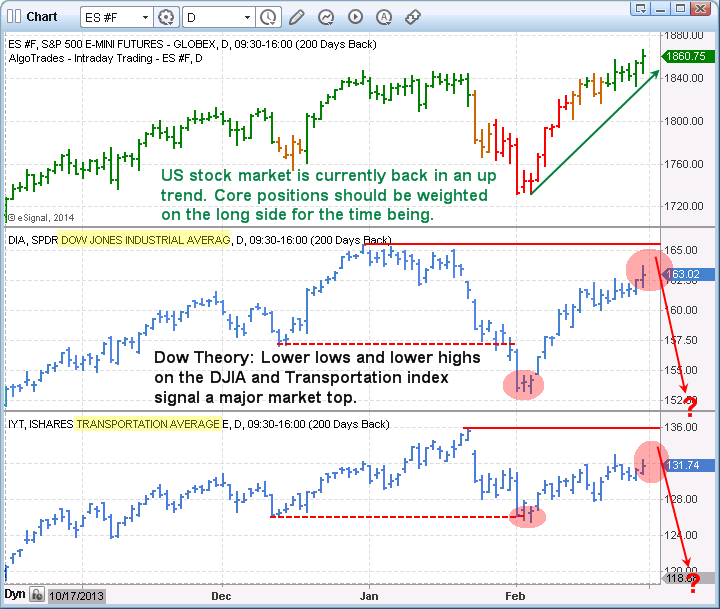
Over the past few weeks I have been watching the DOW and Transportation index closely because it looks and feels like the Dow Theory may play out this year and the stock market could take a 15% haircut.

But what if you skipped on the haircut and opted for a 40% refund?  What? Keep reading to find out how.

Keeping this post short and sweet, I think the U.S. stock market is setting up for a sharp selloff. And it will look a lot like the July 2011 correction. If my calculations are correct this will happen in the next 3-9 weeks and we will see a 15% drop from our current levels. Only time will tell, but I have a way to hedge against this with very little downside risk to you ETF portfolio.

The Dow Theory Live Example for ETF Portfolio

The daily chart of the SP500 index below shows our current trend analysis with green bars signaling an uptrend, orange being neutral, and red signaling bearish price action. Currently the bars are green and we can expect prices to have an upward bias.

The Dow Theory could be  in play. When both the Transports (IYT) and the Dow Jones Industrial Average (DIA) cannot make higher highs and start making lower lows, according to the Dow Theory the broad stock market is topping.

We are watching the market closely because they have both made lower highs and lows.  This rally could stall in the next couple weeks and if so we expect a 15% correction.


Model ETF Portfolio


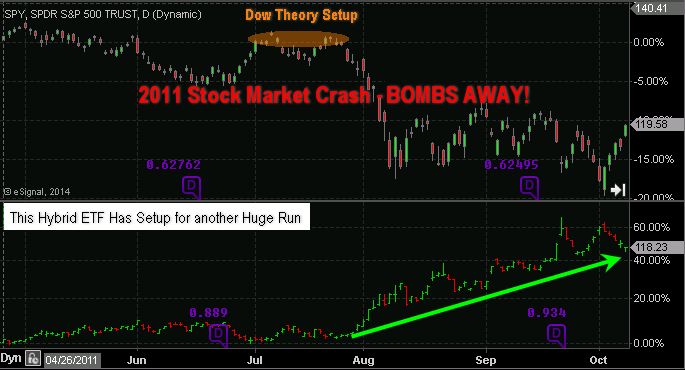
Take a look at the 2011 Stock Market Crash

Model ETF Portfolio Trading

The chart above shows how fearful traders have a delayed reaction to moving money from stocks to a mix of risk-off assets.

The choppy market condition during August and September clearly helped in frustrating investors and created more uncertainty. This helped prices of this ETF portfolio fund rally long after the initial selloff took place. This is something I feel will take place again in the near future and subscribers of my ETF newsletter will benefit from this move.

Because we have a Dow Theory setup, our risk levels are clearly defined as to when to exit the trade if it does not play out in our favor. But with the potential to make 40% and the downside risk only being 4%, it’s the perfect setup for a large portion of our ETF portfolio. And just so you know this is not a precious metals trade as we are already long that sector and up 10% in that position already.

Get My Daily Video Forecasts & ETF Trades Today


Chris Vermeulen
The Gold & Oil Guy.com


Wednesday, February 26, 2014

Appetite for Distraction

By Grant Williams


It was during the siege of Fort Sumter that the story I want to share with you takes place….

This story came to me from the pen of Jared Dillian, the very talented writer of an excellent publication called The Daily Dirtnap; and the moment I read it I knew I had to share it with my readers, because it illustrates perfectly something I have been talking to people about for years.

Readers can, and definitely should check out Jared's fantastic work HERE; and to give you a taste of Jared's enviable narrative prowess, I am going to let him tell you the story as he told it to me:

The Calhoun Mansion

Let me tell you again why I like gold and silver.
I was in Charleston two weekends ago for my mom's birthday. We did a horse and carriage ride, a historical tour, around the city. I always thought those things were cheesy, but as it turns out, the horse and carriage tours are very highly regulated, the tour guides have to pass a series of knowledge exams and then take continuing education. I kid you not! Ours had been doing it for six years, and was good.

So as we went by the Calhoun Mansion on Meeting Street, the tour guide fella starts telling us about the house. It was built by a guy named George Walton Williams, who was the richest guy in town. This was back during the Civil War. It's a 24,000 square foot mansion with 14 foot ceilings. It's just monstrous. It cost $200,000 to build — back in the 1860s! So how did Mr. George Walton Williams make his money?
Well, as you probably know, Charleston is a port city, and during the War, the Union Navy blockaded the port and then bombarded the city for weeks and months, but during this time, there were these guys who were "blockade runners" who would sneak by the navy ships, bringing necessary supplies to the city, which was under siege. Blockade runners made a lot of money — five grand a trip sometimes — but you know who made even more money? George Walton Williams did.
He financed the blockade runners.

Williams was not the only one doing this, but he was the most successful, why? Because he insisted on being paid only in gold and silver. If you know your Civil War history you also know that there was a Confederate currency, and I don't know if Mr. Williams had a particular view on the Confederate dollar, but at the conclusion of the war, the Confederate dollar collapsed, and everyone was left holding the bag — except for George Walton Williams.

Williams became like a J.P. Morgan character in the city — Charleston was the center of Southern finance, and Williams singlehandedly bailed out the Broad Street banks. He also built a pretty cool house.

Sorry to interrupt; I know you were enjoying Jared's prose, but we're just about to get to the point of this story, so I want to make sure everybody is paying close attention.

This next paragraph contains the fundamental principle of investing in gold and silver, which so few people genuinely understand — despite the multitudes of commentators expending countless thousands of words.

Hit 'em between the eyes, Jared:

So these anti gold idiots are just that, idiots, or else they have the memory of a goldfish, because currencies come and currencies go, as sure as night follows day. It is the natural order of things. And as you can see, it's not about trading gold to get rich or getting long gold or buying one by two call spreads or getting fancy, it literally is about protecting yourself in the end. It's not like Williams got rich. He just stayed rich. Everyone else got poor.

It's not like Williams got rich. He just stayed rich. Everyone else got poor.

That's it. Right there.

Thanks, Jared, I'll take it from here.

Click here to continue reading this article from Things That Make You Go Hmmm… – a free weekly newsletter by Grant Williams, a highly respected financial expert and current portfolio and strategy advisor at Vulpes Investment Management in Singapore.


Don't Miss This Weeks Free Trading Webinar...."Making the "Big Trades"